In short
- Sound is a physical vibration: we do not only hear it, we feel it through skin, muscles and bones.
- Vibroacoustics studies how low-frequency sound vibration applied to the body affects health.
- Researchers have proposed several mechanisms, from better blood flow to effects on the nervous system and pain signals.
- Early clinical studies report less pain and better sleep, but the field is still new.
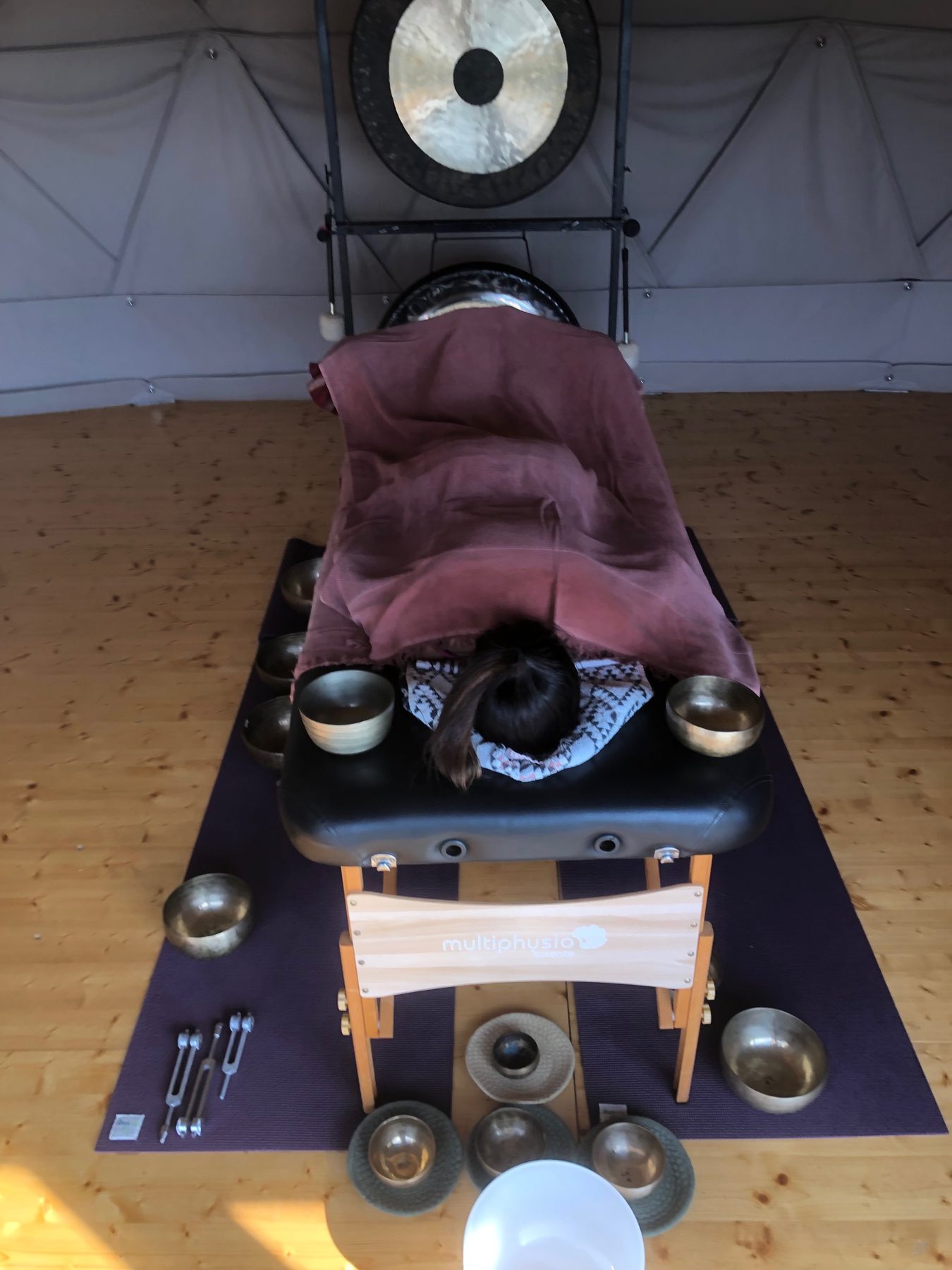
In an individual Opanayko session, singing bowls are placed directly on your body: on the chest, the back, the belly, beside the legs. When Francisco strikes them, you do not just hear a tone. You feel it travel through you. This is where sound healing meets a growing field of research called vibroacoustics.
Sound you can feel
Every sound is a wave of pressure moving through a material. In air, we pick it up with our ears. But sound also moves through liquids and solids, and it travels about four times faster through water than through air. The adult human body is roughly 60% water, held in tissues that conduct vibration well. When a bowl rests on your back, the vibration passes into muscle, fascia and bone, and is picked up by receptors in the skin and deeper tissues that sense touch and pressure.
That is why many people describe a vibrational sound massage as being massaged from the inside. The vibration reaches places that hands cannot easily reach.
What researchers think is happening
A review by music and health researchers at the University of Toronto brought together the possible ways that sound vibration could affect the body [1]. Among them:
- Blood flow. Vibration may stimulate the cells lining the blood vessels to release nitric oxide, a molecule that relaxes the vessels and improves circulation.
- Nerves and pain. Vibration sends a strong stream of touch signals to the spinal cord, which may compete with and dampen pain signals.
- Muscles. Rhythmic vibration affects muscle reflexes and may help muscles release tension.
- The brain. Steady rhythmic stimulation may encourage brain activity to fall into more coherent, synchronised patterns.
The authors are clear that much of this evidence comes from laboratory and early clinical work, and they describe the field as still emerging. But it gives a physical explanation for something people have felt for a long time.
Early clinical findings
In a Canadian study, 19 women with fibromyalgia received low-frequency sound stimulation at 40 Hz, delivered through the body for 23 minutes, twice a week for five weeks. Their pain, mood, sleep and daily activity scores improved substantially, and almost 90% rated their condition as much better. Most also reported that pain began to return in the weeks after treatment ended.
Naghdi et al., Pain Research and Management, 2015 [2]
This study used a specialised device rather than singing bowls, and it had no control group. Still, it suggests that regular sessions of sound you can feel may support people living with pain, and that the benefits, like those of massage or exercise, are strongest when the practice continues.
When singing bowls were used directly, 34 adults showed a lower heart rate and calmer brain activity after the session, and 97% said they felt more balanced.
Walter & Hinterberger, Medicina, 2022 [3]
What a vibrational sound massage feels like
You lie fully clothed on a massage table, covered with a blanket. Bowls are placed on and around you, and some are played close to your ears. Francisco may also use gongs and tuning forks. The session moves slowly: a bowl is struck, the vibration spreads and fades, and another follows. Most people sink into deep relaxation within minutes. Some fall asleep. Many say they feel lighter and more "in their body" afterwards.
Sessions are available for one person or for couples, in private settings or during a retreat. Read more about individual sessions or book a session.
Who should take care
Because the bowls are placed on the body, please tell Francisco before your session if you are pregnant, have a pacemaker or metal implants, epilepsy, recent injuries or any health condition, so the session can be adapted. Research in this area is promising but limited [4], and a sound massage supports wellbeing alongside, not instead of, medical care.
References
- Bartel L, Mosabbir A. Possible Mechanisms for the Effects of Sound Vibration on Human Health. Healthcare. 2021;9(5):597. doi:10.3390/healthcare9050597
- Naghdi L, Ahonen H, Macario P, Bartel L. The effect of low-frequency sound stimulation on patients with fibromyalgia: a clinical study. Pain Research and Management. 2015;20(1):e21-e27. DOAJ record
- Walter N, Hinterberger T. Neurophysiological Effects of a Singing Bowl Massage. Medicina. 2022;58(5):594. doi:10.3390/medicina58050594
- Stanhope J, Weinstein P. The human health effects of singing bowls: A systematic review. Complementary Therapies in Medicine. 2020;51:102412. University of Adelaide record
This article is for general information and does not replace medical or psychological advice.