In short
- A singing bowl produces one main tone plus many overtones, and the sound slowly fades over a long time.
- That long, changing tone gives the mind a natural anchor, much like a mantra or the breath in meditation.
- Studies have measured less tension and low mood, a slower heart rate and calmer brain activity after singing bowl sessions.
- Beginners seem to benefit as much as, or even more than, experienced meditators.
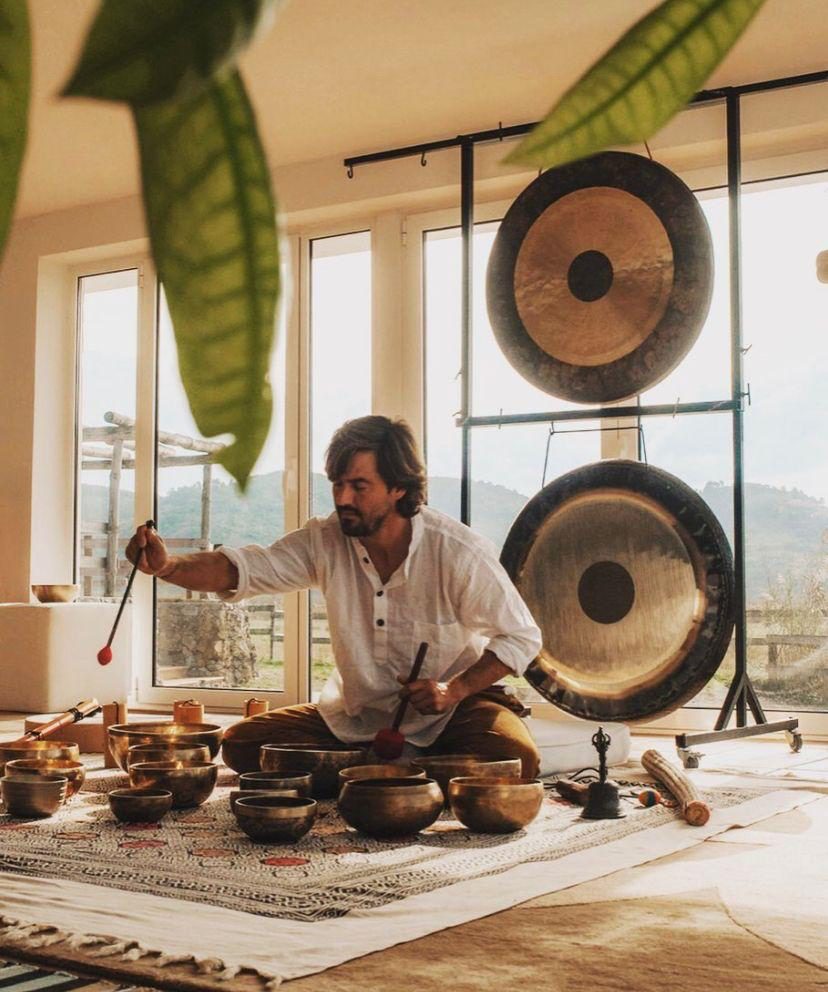
Singing bowls are at the heart of every Opanayko session. They look simple: a metal bowl and a wooden or felt mallet. Yet the sound they make is surprisingly complex, and it seems to have a direct line to the nervous system. Here is what happens, in the bowl and in you, when one is played.
Why a singing bowl sounds the way it does
When a bowl is struck or its rim is circled with a mallet, the metal vibrates in several patterns at once. You hear a deep main tone, called the fundamental, layered with higher tones called overtones. Because traditional bowls are hand-hammered and never perfectly symmetrical, some of these tones sit very close together in pitch. When two close tones meet, they create a slow pulsing, a "wah-wah-wah" that acousticians call beating.
The sound also lasts. A good bowl can keep ringing for a minute or more, slowly fading. As a sound engineer, Francisco chooses bowls for exactly these qualities: the richness of the overtones, the speed of the pulsing and the length of the decay.
What happens in the mind
Most meditation techniques give attention a single, gentle anchor: the breath, a word, a candle flame. A singing bowl does this on its own. The tone is interesting enough to hold attention, but changes so slowly that there is nothing to analyse. Thinking naturally quietens.
In a study of 62 adults, a singing bowl meditation significantly reduced tension, anger, fatigue and depressed mood. Participants who had never done this type of meditation before had a larger drop in tension than experienced meditators.
Goldsby et al., Journal of Evidence-Based Complementary & Alternative Medicine, 2017 [1]
That last finding matters. Many people believe they "can't meditate" because their mind is too busy. With sound, the work of focusing is partly done for you.
What happens in the body
Researchers recorded heart rate, breathing and 64-channel EEG in 34 adults before, during and after a singing bowl session. Heart rate fell from an average of 75.5 to 71.5 beats per minute, and brain activity became quieter overall, with less fast beta and gamma activity.
Walter & Hinterberger, Medicina, 2022 [2]
These are the physical signs of the relaxation response: the parasympathetic nervous system taking over from the stress response. In this state, breathing deepens, muscles soften and the body shifts its energy towards repair, digestion and recovery. Nearly all participants in the study also said they felt more balanced afterwards.
Feeling the sound, not just hearing it
Sound is vibration. In a group sound bath, the vibration reaches you through the air and the floor. In an individual Opanayko session, the bowls are also placed directly on the body, so you feel each strike spreading through your chest, back or legs. Many people describe it as a massage from the inside. We explore this in more detail in our article on vibroacoustics.
A note on the evidence
The research on singing bowls is encouraging but early. A systematic review found only a few peer-reviewed studies, most with positive results but small samples and a risk of bias, and called for more rigorous trials [3]. A singing bowl session is a deeply relaxing experience and a support for wellbeing. It is not a medical treatment, and it works best alongside, not instead of, professional care.
Experience it yourself
The best way to understand a singing bowl is to lie beside one. Francisco offers individual and couples sessions with bowls placed on the body, and group sound baths for retreats across Portugal.
References
- Goldsby TL, Goldsby ME, McWalters M, Mills PJ. Effects of Singing Bowl Sound Meditation on Mood, Tension, and Well-being: An Observational Study. Journal of Evidence-Based Complementary & Alternative Medicine. 2017;22(3):401-406. doi:10.1177/2156587216668109
- Walter N, Hinterberger T. Neurophysiological Effects of a Singing Bowl Massage. Medicina. 2022;58(5):594. doi:10.3390/medicina58050594
- Stanhope J, Weinstein P. The human health effects of singing bowls: A systematic review. Complementary Therapies in Medicine. 2020;51:102412. University of Adelaide record
This article is for general information and does not replace medical or psychological advice.