In short
- Sound healing uses gongs, singing bowls and other instruments to guide the body into deep relaxation.
- Early studies report less tension, anxiety and low mood after a single sound meditation.
- Measurable changes have been recorded in the body too, such as a slower heart rate and calmer brain activity.
- The research is promising but still young: most studies are small and many have no control group.
People often leave a sound bath saying they feel lighter, calmer or "reset". For a long time this was described only in spiritual terms. Over the last decade, researchers have started to measure what actually happens to mood, the nervous system and the brain during a sound session. This article gathers what the studies say, what they do not say yet, and why it matters for how we design each Opanayko session.
What is sound healing?
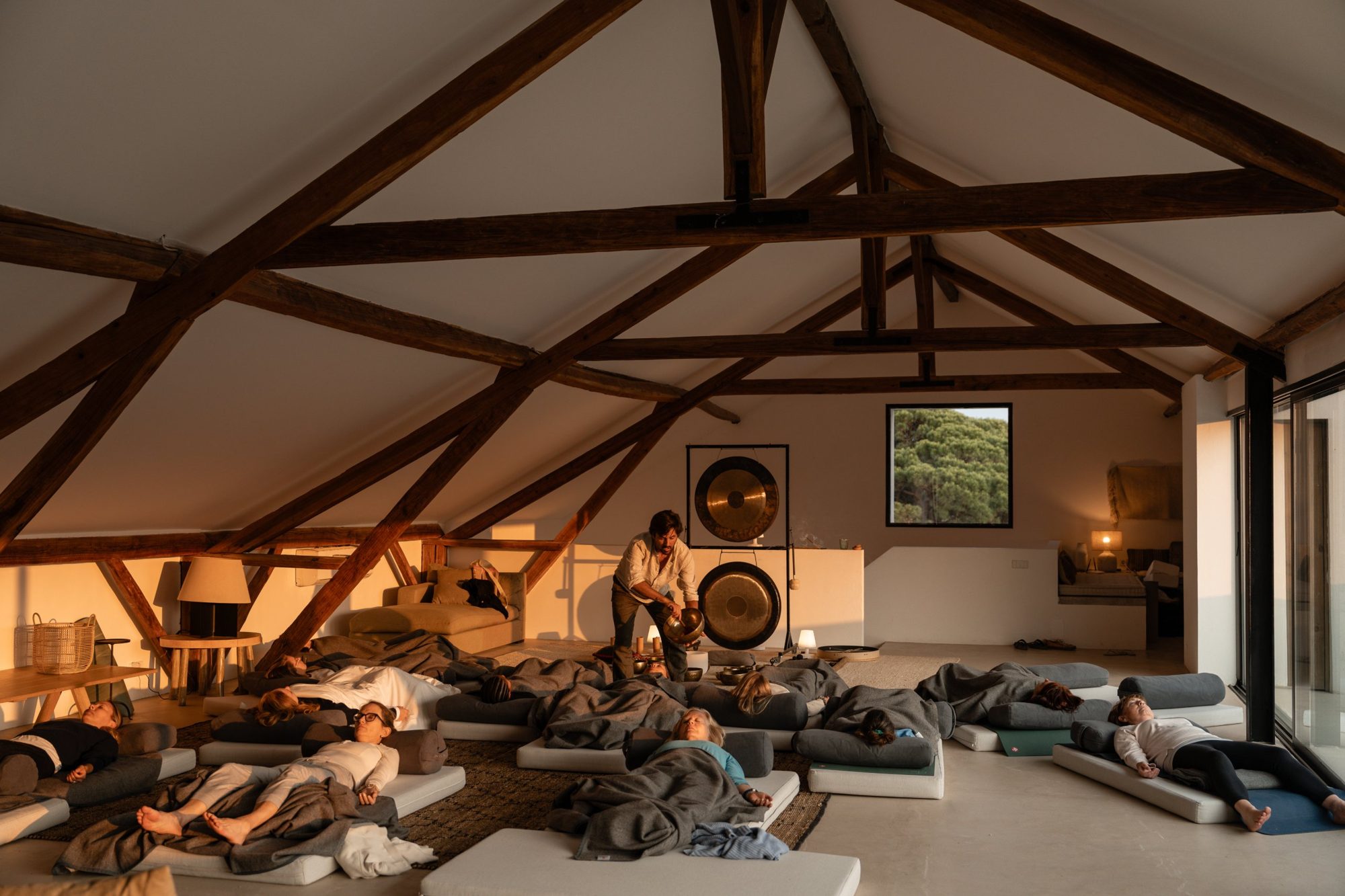
Sound healing, also called sound therapy or a sound bath, is a practice where you lie down and listen to sustained tones and vibrations from instruments such as gongs, Tibetan singing bowls, crystal bowls and tuning forks. There is no music to follow and nothing to do. The long, rich tones and their overtones give the mind something gentle to rest on, and the body is invited to slow down.
Two things happen at once. You hear the sound, which affects attention, emotion and the brain. And you feel it, because sound is a physical vibration that travels through the air, the floor and the body itself.
What the research shows
1. Mood, tension and anxiety
The most cited study was carried out in California. 62 adults took part in a singing bowl meditation and filled in mood questionnaires before and after. Tension, anger, fatigue and depressed mood all dropped significantly, and spiritual wellbeing rose.
Goldsby et al., Journal of Evidence-Based Complementary & Alternative Medicine, 2017 [1]
One detail is especially interesting: people who had never tried this kind of meditation before had a significantly larger drop in tension than experienced meditators. In other words, you do not need to know how to meditate for a sound bath to work. A follow-up analysis by the same team found that the people whose spiritual wellbeing improved most were also those whose tension and low mood eased most [2].
2. Heart rate and the nervous system
In a German study, 34 adults received a singing bowl session while researchers recorded their heart, breathing and brain activity with 64-channel EEG. Average heart rate fell from 75.5 to 71.5 beats per minute after the session, and overall brain activity became quieter, with less of the fast beta and gamma activity linked to active, effortful thinking.
Walter & Hinterberger, Medicina, 2022 [3]
Afterwards, 97% of participants said they felt more balanced and 91% felt more integrated. A slower heart rate and a quieter brain are typical signs of the body moving out of "fight or flight" and into "rest and digest", the state where the body repairs and recovers.
3. Brain waves and rhythm
The brain works in rhythms, measured as brain waves. Fast beta waves dominate when we are alert and busy. Slower alpha and theta waves appear in calm, meditative and dreamlike states. Research on rhythmic sound, mostly on binaural beats, suggests that sound can nudge the brain towards these patterns: a review of 22 studies found a medium-sized effect on anxiety, pain perception and attention, with longer listening giving better results [4].
Gongs and bowls are not the same as binaural beats, so this does not prove that a sound bath "tunes" your brain waves. But it supports what people feel: steady, slow sound helps the mind let go.
What we do not know yet
Honesty matters here. A systematic review of the research on singing bowls found only a handful of peer-reviewed studies. Their results were mostly positive, including less distress, anxiety, depression and fatigue, but the studies were small and had a risk of bias, so the authors concluded that more rigorous research is needed before firm recommendations can be made [5].
Most studies so far measure people before and after a single session, without a comparison group. That means part of the effect could come from simply lying down in a calm room. For the person on the mat, that may not matter much. For science, it means the field is still young.
How this shapes an Opanayko session
The research points in the same direction as Francisco's experience since 2017: the deepest effects come when the body feels safe enough to let go. That is why every group session starts with guided breathing and a body scan, gives about an hour to the deep sound journey, and ends with a slow, held return. It is also why sessions are long enough for the nervous system to really settle, rather than a quick 20-minute experience.
If you lead retreats, a sound bath is a simple way to offer your group something that many find deeply restorative, with no experience needed. You can see how a retreat session works or send an enquiry.
References
- Goldsby TL, Goldsby ME, McWalters M, Mills PJ. Effects of Singing Bowl Sound Meditation on Mood, Tension, and Well-being: An Observational Study. Journal of Evidence-Based Complementary & Alternative Medicine. 2017;22(3):401-406. doi:10.1177/2156587216668109
- Goldsby TL, Goldsby ME, McWalters M, Mills PJ. Sound Healing: Mood, Emotional, and Spiritual Well-Being Interrelationships. Religions. 2022;13(2):123. doi:10.3390/rel13020123
- Walter N, Hinterberger T. Neurophysiological Effects of a Singing Bowl Massage. Medicina. 2022;58(5):594. doi:10.3390/medicina58050594
- Garcia-Argibay M, Santed MA, Reales JM. Efficacy of binaural auditory beats in cognition, anxiety, and pain perception: a meta-analysis. Psychological Research. 2019;83(2):357-372. PubMed 30073406
- Stanhope J, Weinstein P. The human health effects of singing bowls: A systematic review. Complementary Therapies in Medicine. 2020;51:102412. University of Adelaide record
This article is for general information and does not replace medical or psychological advice.